Share this post
Introducing Expanded Web Search: Social Media, People, Company, News, GitHub and More
Now Storytell can enhance, augment and remix your internal data with almost any type of external web data
January 9, 2026

🚀 The Game-Changer
Storytell now speaks eight distinct languages of the web. This release introduces category-intelligent search powered by Storytell's ability to use Exa's API as a tool —a fundamental shift from generic web search to specialized information retrieval that understands the unique structure of different content types.
What this means for you: Storytell can now orchestrate sophisticated multi-source analysis workflows that were previously impossible, combining your internal documents with precisely targeted external intelligence from across the web.
🎯 Eight Specialized Search Engines in One Platform
Each category leverages optimized search logic tailored to how that content type is structured, indexed, and consumed. Using the right category doesn't just improve results—it fundamentally changes what's findable.
1. People Search – The Human Intelligence Network
What it finds: Employees, researchers, executives, professionals by role, title, or company affiliation
Optimized for: Professional profiles, organizational hierarchies, expert discovery
Use cases that are now trivial:
- "Find AI researchers at Google who work on transformer architectures"
- "Who are the executives at companies building autonomous vehicles?"
- "Engineers working on Rust at major tech companies"
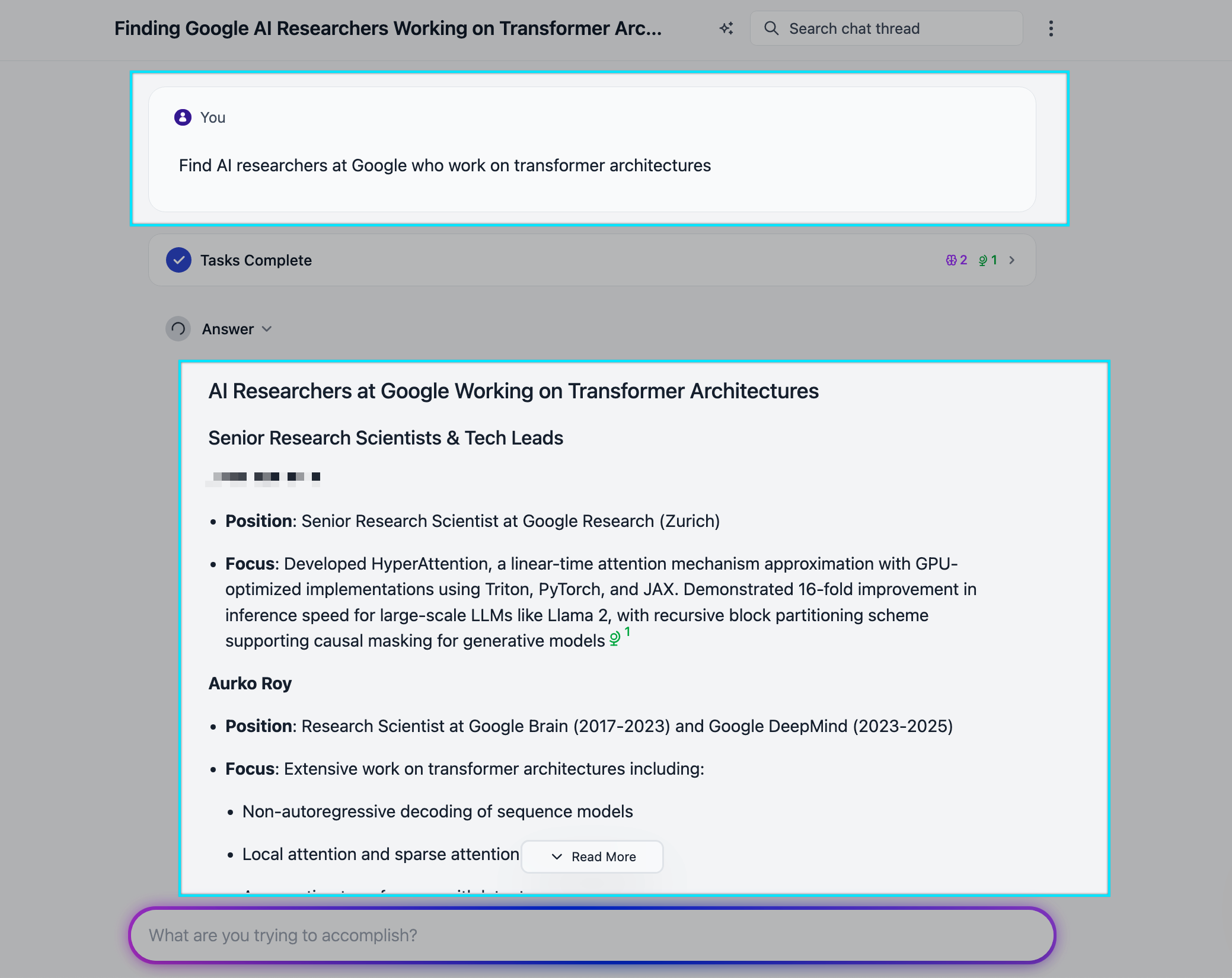
Why this matters: When analyzing competitive landscapes or sourcing expertise, Storytell can now automatically identify key individuals, validate their credentials against your internal research, and map professional networks—all in one workflow.
2. Company Search – Market Intelligence at Scale
What it finds: Businesses, startups, organizations, products, services
Optimized for: Corporate information, competitive analysis, market landscapes
Use cases that are now trivial:
- "What startups are building AI code assistants?"
- "Companies in the autonomous vehicle space with recent funding"
- "B2B SaaS companies targeting healthcare compliance"
Why this matters: Combine this with your internal strategy docs, financial models, or market research. Storytell can now pull live competitive intelligence from the web and cross-reference it against your internal assumptions—validating market sizing, identifying new competitors, or surfacing acquisition targets.
3. Research Paper Search – Academic Intelligence Layer
What it finds: Academic studies, peer-reviewed publications, scientific papers
Optimized for: Scholarly literature, methodology validation, citation networks
Use cases that are now trivial:
- "Recent advances in retrieval augmented generation"
- "Peer-reviewed studies on transformer architectures for NLP"
- "Clinical trials for cancer immunotherapy published in 2025"
Why this matters: When writing whitepapers, grant proposals, or technical documentation, Storytell can now surface the latest research, extract methodologies, and validate claims against the academic literature—then synthesize everything alongside your internal R&D notes or product specs.
4. News Search – Real-Time Context Engine
What it finds: Current events, breaking stories, press releases, journalism
Optimized for: Timeliness, editorial content, news cycles
Use cases that are now trivial:
- "Latest AI regulation developments in the EU"
- "Recent tech layoffs at major companies"
- "Breaking news about quantum computing breakthroughs"
Why this matters: Layer live news over your internal planning documents. Ask Storytell to analyze how recent regulatory changes impact your roadmap, or how competitor announcements validate (or invalidate) your strategic assumptions. The platform now maintains temporal awareness of external events while reasoning over your private data.
5. GitHub Search – Technical Intelligence & Code Discovery
What it finds: Code repositories, frameworks, open source tools, libraries
Optimized for: Developer ecosystems, implementation patterns, technical architecture
Use cases that are now trivial:
- "Best Go testing frameworks with recent activity"
- "Python ML libraries for time series forecasting"
- "React component libraries with TypeScript support"
Why this matters: When evaluating technical decisions or conducting vendor research, Storytell can now survey the open source landscape, assess community momentum, extract implementation patterns from READMEs, and compare findings against your internal architecture docs or tech stack decisions.
6. Tweet Search – Real-Time Sentiment & Social Intelligence
What it finds: Twitter/X posts, social media reactions, opinions, hot takes
Optimized for: Public sentiment, viral trends, community reactions
Special capability: Up to 50 results (5x standard) given tweets' concise format
Use cases that are now trivial:
- "Developer reactions to new React features"
- "What are people saying about GPT-5?"
- "Public sentiment about recent product launch"
Why this matters: This is your early warning system. Storytell can now monitor social sentiment around competitors, track reactions to your own announcements, or gauge community reception of industry trends—then cross-reference against your internal metrics or customer feedback data to validate signals or identify blind spots.
7. Personal Site Search – Practitioner Knowledge & Lived Experience
What it finds: Blog posts, personal websites, tutorials, developer experiences
Optimized for: Individual perspectives, practical experiences, how-to content
Use cases that are now trivial:
- "Developer experiences migrating to Rust"
- "Personal blog posts about remote work productivity"
- "Startup founder reflections on product-market fit"
Why this matters: Academic papers tell you what should work in theory. Personal blogs tell you what actually works in practice. Storytell can now harvest practitioner wisdom from across the web—implementation gotchas, migration strategies, cultural insights—and weave it into analysis alongside your own lessons learned or internal postmortems.
8. Financial Report Search – Corporate Disclosure Intelligence
What it finds: SEC filings, 10-K/10-Q reports, earnings reports, quarterly results
Optimized for: Regulatory disclosures, financial statements, investor documents
Use cases that are now trivial:
- "Apple Q4 2025 earnings report"
- "Tesla SEC filings mentioning battery technology"
- "10-K risk factors for autonomous vehicle companies"
Why this matters: When building financial models, competitive analyses, or investment theses, Storytell can now pull audited financial data directly from regulatory filings, extract risk factors, track M&A activity, and validate assumptions against what public companies are actually reporting to shareholders—all while reasoning over your internal financial projections.
💡 Turbocharging Storytell: Advanced Multi-Source Analysis Patterns
The true power emerges when you combine these categories with your internal knowledge base. Here's what's now possible:
Pattern 1: Competitive Intelligence Fusion
The workflow:
- Search Company category for competitors in your space
- Pull their Financial Reports to understand revenue, risks, growth
- Find key People at those companies (executives, lead researchers)
- Check News for recent announcements or funding rounds
- Monitor Tweets for customer sentiment about their products
- Cross-reference everything against your internal strategy docs and market research
The outcome: A living competitive intelligence dashboard that updates with the latest external signals while validating against your internal assumptions.
Pattern 2: Research-Backed Product Development
The workflow:
- Search Research Papers for latest academic work in your domain
- Find GitHub repositories implementing those techniques
- Read Personal Sites from practitioners who tried similar approaches
- Check News for industry adoption or regulatory developments
- Synthesize findings alongside your internal product specs and R&D notes
The outcome: Evidence-based product roadmaps that ground internal innovation in both academic research and real-world implementation experience.
Pattern 3: Market Validation & Trend Triangulation
The workflow:
- Pull News on emerging trends or market shifts
- Find Companies capitalizing on those trends
- Check Tweets for organic demand signals and community excitement
- Review Financial Reports for investors' perspective on market viability
- Search Research Papers for scientific validation of underlying technology
- Compare external signals against your internal market sizing and forecasts
The outcome: Multi-source validation that separates genuine market opportunities from hype cycles.
Pattern 4: Expert Discovery & Knowledge Synthesis
The workflow:
- Find People who are experts in a technical domain
- Search their Personal Sites or blog posts for their perspective
- Review their GitHub contributions to assess technical depth
- Check Tweets for their take on current developments
- Find Research Papers they've authored or cited
- Synthesize their expertise alongside your internal subject matter experts' notes
The outcome: Comprehensive expert profiles that map external knowledge networks onto your internal knowledge base.
Pattern 5: Risk Monitoring & Early Warning System
The workflow:
- Monitor News for regulatory changes, security incidents, market disruptions
- Check Tweets for early signals of community concern or excitement
- Review Financial Reports for how public companies are disclosing similar risks
- Search Research Papers for technical analysis of emerging threats
- Cross-reference against your internal risk registers and compliance docs
The outcome: An intelligent early warning system that surfaces external risks and validates them against your internal risk framework.
🧠 How It Works: Semantic Understanding at the Core
Every category search is powered by semantic understanding, not just keyword matching. The system interprets conversational queries and handles synonyms automatically.
This query: "What are the latest developments in quantum computing?"
Automatically finds results about: quantum breakthroughs, qubit advances, quantum algorithm progress, quantum computing innovations
You don't need to say: "quantum computing developments advances progress breakthroughs innovations" (keyword stuffing actually hurts search quality)
The semantic engine understands that:
- "Machine learning" finds results about "ML," "artificial intelligence," and "neural networks"
- "Affordable flights" surfaces "cheap airfare" and "budget travel"
- "Engineers at Amazon" finds employee profiles, not job postings
⚡ Performance: Built for Speed
Two search modes balance quality and latency:
- Auto (recommended): Intelligent search optimization with ~1-second latency—best for most use cases
- Fast: Sub-500ms results when speed is critical for quick lookups
This means Storytell can execute multi-category search workflows in seconds, not minutes.
📋 What Changed Under the Hood
Before: Four search types (neural, keyword, auto, fast) required manual selection and query optimization
After: Two streamlined types (auto, fast) with automatic semantic matching and intelligent category routing
Result limits:
- Standard categories: 10 results (default)
- Tweet category: Up to 50 results (optimized for high-volume social monitoring)
🎓 Best Practices: Getting Maximum Value
1. Think in Natural Language
Write queries as you would speak. The system understands conversational intent.
✅ Good: "AI researchers at OpenAI working on language models"
❌ Bad: "AI researchers OpenAI language models LLM GPT neural networks"
2. Always Use Categories When Intent Is Clear
Category selection significantly improves result quality. When your search intent clearly maps to a category, use it.
3. Chain Categories for Multi-Source Analysis
Don't limit yourself to one category per analysis. Build workflows that pull from multiple categories and triangulate findings against your internal data.
4. Trust Semantic Matching
The system automatically handles synonyms, typos, and variations. Focus on clearly expressing your intent rather than listing all possible phrasings.
🔮 What This Enables Going Forward
This release transforms Storytell from a knowledge base assistant into an intelligence synthesis platform. You can now:
- Ground internal strategy in external reality: Validate assumptions against market signals
- Accelerate research: Pull from academic, practitioner, and industry sources simultaneously
- Monitor blind spots: Surface external developments that challenge internal consensus
- De-risk decisions: Triangulate findings across multiple independent sources
- Discover hidden connections: Link your internal experts to external knowledge networks
- Build living documents: Create analyses that stay current with external developments
The barrier between "what we know internally" and "what the world knows" just collapsed. Every category is a new lens for understanding how external intelligence relates to your private data.
Gallery
No items found.
Changelogs
Here's what we rolled out this week
No items found.