Blog
blog category

The Evolution of Software Delivery Models: Why AI Threatens the SaaS Paradigm

By
DROdio
February 6, 2026
The Evolution of Software Delivery Models: Why AI Threatens the SaaS Paradigm

I was discussing Stephanie Palazzolo's article "Anthropic Releases New AI, Hurting Financial Services Stocks" with my Sr. Backend Eng Shelby and he had a really good POV on the hammering SaaS companies have received in the public markets this week:

"We're entering a world where the "Build vs. Buy" equation has shifted. And we've seen this movie before."

Shelby partnered with Storytell to write this piece based on that observation:

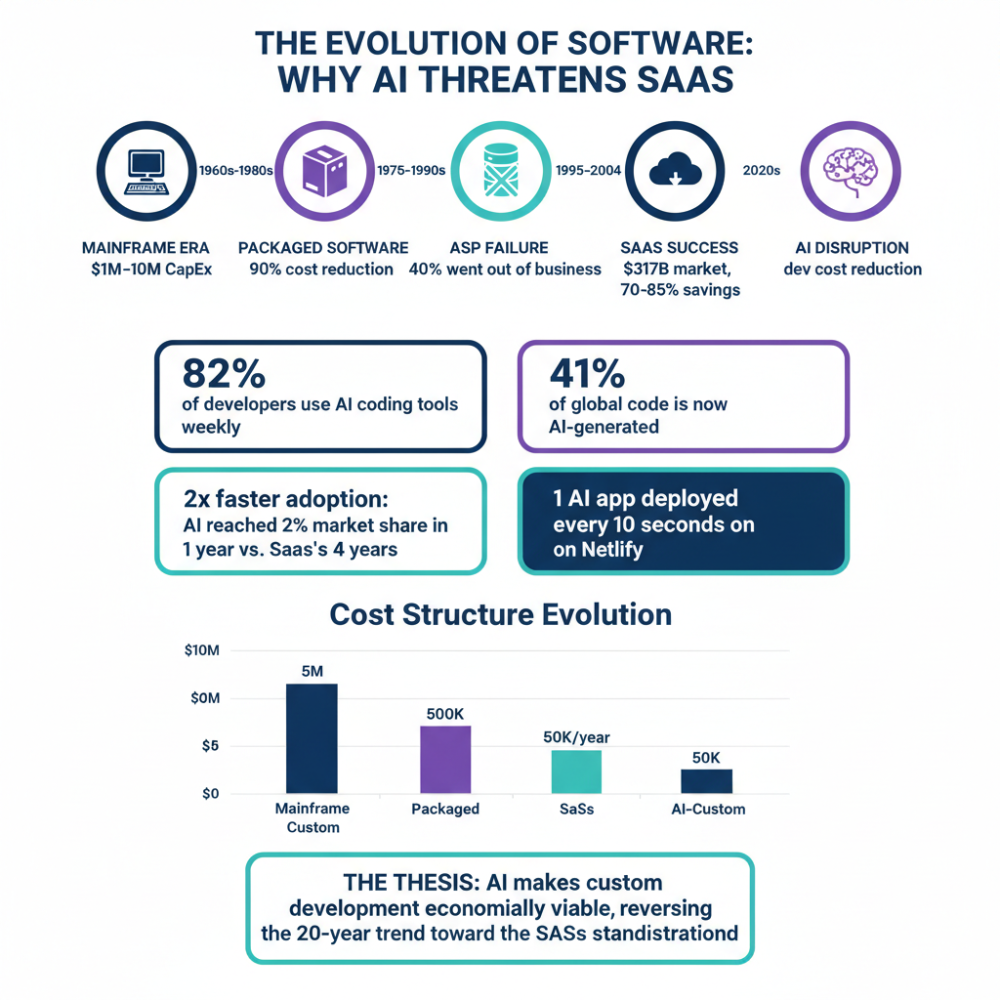
The software industry has undergone four major paradigm shifts, each driven by technological advances that made software dramatically more accessible and cost-effective. Understanding this pattern reveals why AI-generated code represents an existential threat to traditional SaaS business models.
Article content

Era 1: The Mainframe Custom Software Era (1960s-1980s)

When IBM announced the System/360 in 1964, it revolutionized commercial computing by establishing a standardized architecture. By the time the AS/400 launched in August 1988, IBM had created an ecosystem with 111,000 installations by 1990, growing to 500,000 by 1997.

Economic Structure:

  • Capital expenditure: Millions of dollars for hardware with bundled software
  • Deployment time: 12-36+ months for custom development
  • Staffing: Dedicated IT departments and contract programmers
  • Barrier to entry: Only large enterprises, government agencies, and universities could participate

Before the 1969 DOJ settlement forced IBM to unbundle software from hardware, virtually all software was custom-written. Each organization's business processes were considered unique enough to require bespoke solutions. The global packaged software market barely existed—less than $3 billion globally in 1981.

What triggered the transition: Standardization became economically viable as businesses recognized that many processes (accounting, payroll, inventory) followed similar patterns across organizations.

Era 2: Packaged Software Emergence (1970s-1990s)

The emergence of packaged software fundamentally altered the economics of software consumption. Key milestones:

  • Oracle Database released in 1979, grew to 40% database market share by 1992 with $545M in revenue
  • Lotus 1-2-3 launched January 1983 at ~$495 per license
  • The U.S. software market exploded: $994M (1970) → $2.2B (1975) → $19.5B (1985) → $44.5B (1990)

Economic Revolution:

  • Cost reduction: $500 packaged software vs. $50,000+ custom development (90%+ savings)
  • Deployment speed: Weeks/months instead of years
  • Barrier lowering: Thousands instead of millions

Organizations sacrificed customization for cost efficiency. The decision framework emerged: standardize commodity functions (accounting, word processing) and customize only for competitive differentiation. By the 1990s, software product revenue had overtaken services revenue, marking the ascendancy of the one-to-many model.

What triggered the next transition: The internet promised to eliminate even the residual friction of physical distribution and on-premises installation.

Era 3: The ASP False Start (1995-2004)

Mid-1990s Application Service Providers (ASPs) attempted to deliver software over the internet, forming the ASP Industry Consortium in 1999 with players like HP, SAP, and Qwest. Market projections were euphoric—IDC estimated $7.8B by 2004, Gartner predicted $25.3B.

Reality: 40% of ASPs active in 2001 were out of business by 2004.

  1. Single-tenant architecture: Each customer required a separate server instance, preventing economies of scale
  2. Infrastructure immaturity: Pre-broadband internet (dial-up era) caused performance issues
  3. Prohibitive hosting costs: Couldn't reduce operational costs enough to justify value proposition
  4. Organizational resistance: IT departments saw ASPs as threats to budgets and power

The ASP model attempted to solve the right problem (reduce capital expenditure, simplify IT) with the wrong architecture at the wrong time.

What triggered the SaaS revolution: Multi-tenant architecture + cloud computing infrastructure + ubiquitous broadband fundamentally changed the unit economics.

Era 4: The SaaS Revolution (2000s-Present)

Salesforce, founded in February 1999, launched in 2000 with its famous "No Software" campaign. The company went public in June 2004, raising $110 million. By 2025, Salesforce serves 150,000+ customers with ~$35B+ in annual revenue.

Economic Transformation:

  • Multi-tenant architecture: One infrastructure serving millions of customers
  • Cost reduction: 70-85% savings vs. on-premises software
  • Deployment speed: Days to weeks instead of 12-36 months
  • Pricing model: $25-$300 per user per month (started at ~$50/user/month)
  • Market explosion: $1B (2004) → $317B (2025), growing 18.7% annually
  1. Technology maturation: AWS (2006), Azure, and GCP provided scalable cloud infrastructure
  2. Architectural innovation: Multi-tenant design achieved true economies of scale
  3. Broadband ubiquity: High-speed internet became standard
  4. Continuous delivery: Automatic updates (Salesforce releases 3x/year) eliminated upgrade cycles
  5. API ecosystems: Integration standards solved interoperability challenges

By 2025, 94% of enterprises use cloud services, and SaaS represents ~$195B of the top 500 U.S. software firms' revenue.

Even during SaaS's dominance, custom development never disappeared. Organizations continued building custom software when:

  • Competitive differentiation required unique capabilities
  • Complex integration with proprietary systems was necessary
  • ROI justified costs: If custom delivered 150-300% ROI within 24 months

However, the economics remained challenging:

  • Custom builds typically cost 5-10x initial estimates including maintenance
  • Only 16% of IT projects meet all success criteria (budget, timeline, outcomes)
  • 35% of large enterprise custom projects are abandoned
  • Annual maintenance consumes 15-20% of original build cost

This created the classic "build vs. buy" framework: buy standardized SaaS for commodity functions, build custom only for strategic differentiation.

What is triggering the next transition: AI is collapsing the cost, time, and skill barriers to custom software development.

Era 5: The AI-Enabled Custom Development Era (2020s-Present)

Adoption Timeline:

  • GitHub Copilot launched June 2021, now has 20M+ users and 42% market share
  • Cursor launched 2023, reached $9.9B valuation in just 18 months with 18% market share
  • Current penetration: 82% of developers use AI coding assistants weekly (2025)
  • Impact: 41% of all code globally is now AI-generated

Market Growth:

  • AI coding tools market: $4.8B (2025) → $17.2B (2030), representing 35% CAGR
  • Enterprise gen AI spend: $15B in 2023 alone—reaching 2% of the software market in just 1 year
  • Critical comparison: SaaS took 4 years to reach 2% market share; AI reached it in 1 year

AI adoption is 2x faster than SaaS adoption was.

  • 30-50% time saved on repetitive coding tasks
  • 30-40% faster debugging
  • Up to 50% time saved on code documentation
  • 30-40% reduction in unit test generation time

Perhaps most significantly, AI is enabling non-engineers to build functional applications. One documented example: a non-engineer built a functional app "half a bottle of wine later" that replicated a multi-million dollar company's functionality.

Current deployment velocity: 1 new AI-built app is deployed on Netlify every 10 seconds.

The Thesis: Why AI is a Structural Threat to SaaS

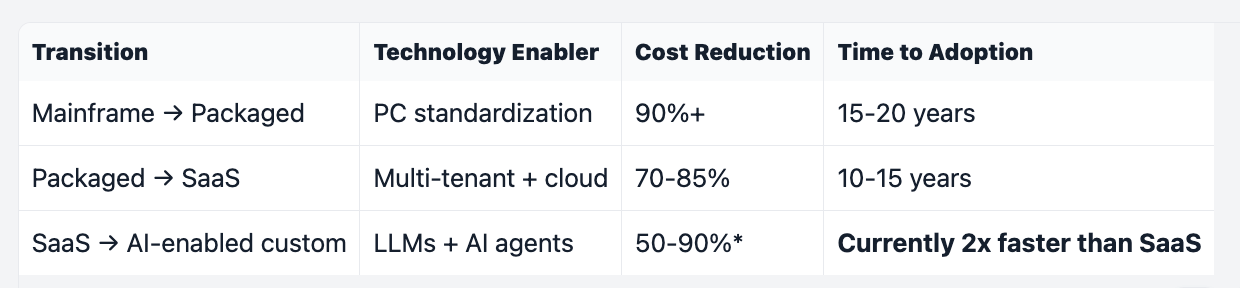
Every software delivery paradigm has been disrupted by a successor that solved the same problems more efficiently and more cheaply:
Article content

AI is reducing custom development costs by 50-90%, making custom competitive with SaaS subscription costs at scale.

Traditional Economics (Pre-AI):

  • Custom development: $100,000-$10M initial + 15-20% annual maintenance
  • SaaS: $25-$300/user/month with no maintenance burden
  • Decision: Buy SaaS unless strategic differentiation justifies custom investment

AI-Enabled Economics (Current):

  • AI-assisted custom development: $10,000-$100,000 (50-90% reduction)
  • Development time: Weeks instead of months
  • New decision framework: Custom becomes viable for problems that previously required accepting "good enough" SaaS solutions

When custom software becomes economically competitive with SaaS subscriptions, the primary reason to tolerate standardized solutions disappears.

Seat-based pricing model threatened:

  • Traditional SaaS: Revenue = (number of human users) × (price per seat) × (retention rate)
  • AI agent era: One AI agent can replace multiple human users
  • Example: AI agents automate workflows that previously required 10 SaaS seats across multiple tools

Salesforce's response signals the threat: The company launched "Agentforce" autonomous agents in 2024, explicitly recognizing that AI agents will replace traditional per-seat licensing models.

Industry Analysis:

  • McKinsey (2024): "Gen AI is causing a 'sizeable shift in value pools' across software categories"
  • Bain (2025): "Disruption is mandatory. Obsolescence is optional."
  • HFS Research: "Generative AI eats SaaS"
  • Business Insider: "AI coding tools threaten the SaaS business model"

Market Bifurcation:

Infrastructure Software (Winners):

  • Cloud infrastructure providers benefit from AI computational demand
  • Platform companies with deep integration ecosystems remain defensible
  • Growth rate: +15.4% for infrastructure software

Application SaaS (Vulnerable):

  • Niche, feature-limited, seat-based SaaS products face commoditization
  • Simple workflow automation tools can be replicated by AI in hours
  • Products with weak data moats and low switching costs are most exposed

AI model costs are collapsing:

  • OpenAI o3 pricing dropped 80% in just 2 months
  • As model costs approach zero, any routine digital task will move from "human + SaaS app" to "AI agent + API"
  • SaaS companies face margin compression as AI automates the workflows their products currently charge for

SaaS Era Logic: Standardization = economies of scale = lower cost

  • One-to-many model enabled venture-scale returns
  • Network effects and platform ecosystems created moats

AI Era Logic: AI enables "mass customization" at standardized costs

  • Why accept a standardized CRM when AI can build a custom one tailored to your exact process in days?
  • Why pay for features you don't use when AI can generate exactly what you need?

The 20-year trend toward standardization is reversing because AI makes customization economically viable again.

Which SaaS Companies Are Most Vulnerable?

Characteristics:

  • Niche, single-feature products
  • Seat-based pricing models
  • Simple workflow automation
  • Weak proprietary data moats
  • Low switching costs
  • Limited integration ecosystems

Examples: Single-purpose tools for scheduling, form-building, simple CRMs, basic project management

Why vulnerable: An AI agent can replicate these features in hours or days, customized to exact needs, at a fraction of the subscription cost.

Characteristics:

  • Multi-feature suites with some integration
  • Some proprietary data but not core to business model
  • Moderate switching costs

Response required: Integrate AI deeply, shift pricing from seats to outcomes, build stronger data network effects

Characteristics:

  • Platform ecosystems with deep integrations (e.g., Salesforce AppExchange)
  • Products controlling critical proprietary data (e.g., financial systems of record)
  • Strong network effects where value increases with users
  • Infrastructure software benefiting FROM AI demand

Why defensible: Switching costs are prohibitive, data moats are defensible, and ecosystem effects create lock-in.

The software industry's history shows a clear pattern: technological paradigms that dramatically reduce cost and increase accessibility always disrupt incumbent delivery models.

  • 1970s-1980s: Packaged software disrupted custom mainframe development by reducing costs 90%
  • 2000s-2010s: SaaS disrupted packaged software by reducing costs 70-85%
  • 2020s: AI-enabled custom development is disrupting SaaS by reducing custom development costs 50-90%

The thesis is not speculative—it is already happening:

  • AI adoption is 2x faster than SaaS adoption
  • 41% of code is now AI-generated
  • Non-engineers are building functional applications
  • Enterprise AI spend reached 2% of software market in just 1 year

The strategic question for SaaS companies is not WHETHER disruption will occur, but HOW to respond:

  1. Own the data layer (become the system of record)
  2. Build AI-native interfaces (agents, not seats)
  3. Price for outcomes, not users (value-based vs. seat-based)
  4. Deepen integration ecosystems (increase switching costs)
  5. Recognize infrastructure software (picks and shovels) will benefit from AI's rise

The companies that built SaaS empires by standardizing software delivery now face the same disruption that mainframe vendors and packaged software companies faced before them. The standardization that created their competitive advantage is becoming their vulnerability in an era where AI makes customization economically viable.

History doesn't repeat, but it rhymes. And the pattern is clear: the next paradigm always wins by making the expensive and complex become cheap and accessible. AI is doing exactly that to custom software development, and SaaS sits directly in the path of that disruption.

Gallery

Changelogs

Here's what we rolled out this week
No items found.

Related Posts

No blog posts at this time